Warehouse Air Coolers: A Buyer’s Sizing Checklist
News Details
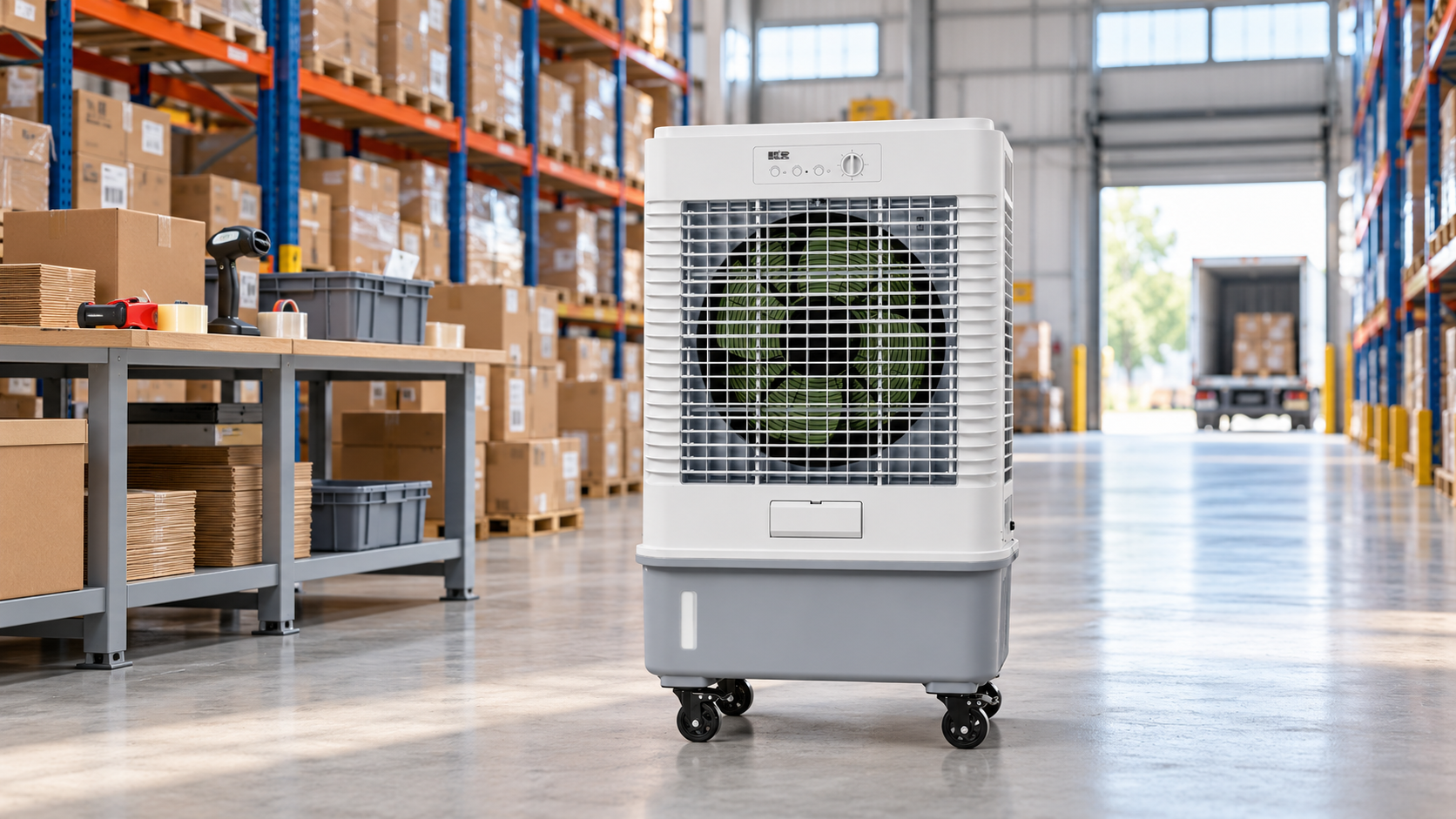
Choosing a warehouse air cooler takes more than checking floor area. Ceiling height, local humidity, rack layout and heat from daily work all affect the choice. A unit that works well beside a packing station may not serve a long aisle in the same way.
Therefore, start with a clear goal: which areas need cooling, when are they occupied, and what conditions must the equipment handle?
This warehouse air cooler sizing checklist helps buyers gather the right information, compare suitable models and plan a useful site trial before placing an order.
Start with Your Warehouse Spot Cooling Needs
First, decide whether you need cooling across a large working area or around selected workstations.
Warehouse spot cooling focuses on occupied zones, such as packing benches, sorting stations and dispatch areas. This approach can be practical when staff work in a few fixed locations within a much larger building.
Mark these zones on a simple floor plan. Then, record:
- The number of people working in each zone.
- The hours when each area is occupied.
- The distance between workstations.
- Nearby machines, doors and other heat sources.
- Routes used by forklifts and pallet trucks.
For example, a warehouse with two packing stations and a dispatch desk may need separate airflow paths. One large unit at the entrance may leave some workers behind racks with little benefit.
Check the Climate Before Choosing an Industrial Air Cooler
A direct evaporative industrial air cooler passes air through wet cooling pads. As water evaporates, it cools the passing air and adds moisture. Consequently, this process works best in dry conditions, while high humidity limits its cooling effect.
For a useful assessment, collect temperature and relative humidity readings during the hottest working hours. Monthly averages alone may hide the conditions that matter most.
Also, tell the supplier whether the warehouse stores goods with strict moisture limits. The cooling plan must suit both the working area and the stored products.
If the building requires close temperature and humidity control, discuss those requirements before selecting equipment. A portable evaporative cooler should not be chosen on the assumption that it will deliver the same control as a refrigerated air-conditioning system.
Measure the Space for Warehouse Air Cooler Sizing
Next, measure the building and the specific zones you want to serve.
| Information to collect | Why it matters |
|---|---|
| Warehouse length and width | Defines the overall layout |
| Ceiling height | Adds context beyond floor area |
| Workstation locations | Shows where cooled airflow is needed |
| Rack height and aisle width | Identifies barriers to airflow |
| Door positions and opening times | Helps assess incoming air and exit paths |
| Machinery and sun-exposed walls | Highlights local heat sources |
| Existing fans and extraction systems | Helps assess how air already moves |
You can calculate building volume using:
Building volume (m³) = length (m) × width (m) × height (m)
However, volume alone does not determine the number of portable coolers required. For spot cooling, the distance to workers, airflow direction and obstructions also matter.
Send the supplier a marked floor plan and site photos alongside these measurements.
Compare Airflow, Air Throw and Coverage Claims
When reviewing a portable warehouse air cooler, ask what each performance figure actually measures.
Airflow, usually stated in m³/h or CFM, describes the volume of air moved over time. Air throw describes how far the air stream travels under stated test conditions. Meanwhile, a quoted coverage area depends on assumptions about the space and operating environment.
These figures answer different questions. A long air throw does not prove that every workstation within that distance will receive useful cooling.
Ask the supplier:
- Is the airflow figure measured with the cooling pads installed?
- Which speed setting was used?
- What test method supports the stated air throw?
- What conditions support the suggested coverage area?
- Are noise and power figures available at the intended operating speed?
Also, avoid treating the number in a model name as a confirmed airflow rating. Request the current specification sheet.
Plan Placement for a Portable Warehouse Air Cooler
Placement can change the result as much as model size.
Keep the intake clear of walls, cartons and stored goods. Then, direct the outlet towards the occupied zone without blocking pedestrian or vehicle routes.
Evaporative cooling also needs a suitable air exit path. In an enclosed space, moisture can build up and reduce performance. Therefore, review the location of doors, openings and any designed exhaust system before choosing where to place the cooler.
For warehouses with several separated work areas, ask the supplier to compare a single larger unit with multiple smaller units. Evaluate the layout, power connections, refill work and ease of moving each unit.
Check Water Supply, Power and Maintenance Access
A large water tank may reduce refill frequency, but it does not automatically produce colder air.
Before ordering, confirm the usable tank capacity, expected water consumption and refill method for the exact model. Ask what weather conditions and speed setting were used to measure water use.
Then, check practical site requirements:
- Voltage, frequency and plug type.
- Suitable electrical connections near the planned location.
- Access to clean water.
- Space for tank drainage and cleaning.
- Access to cooling pads and the pump.
- Availability of replacement parts.
Water quality also matters. Mineral deposits can restrict airflow through the pads and reduce performance, so cleaning and inspection should follow the manufacturer’s instructions.
Match Your Checklist to LEBON Warehouse Air Coolers
LEBON manufactures evaporative air coolers and industrial fans for commercial and industrial applications. Its mobile equipment allows buyers to plan airflow around the areas where it is needed.
Two relevant product options to discuss are:
MFC12000D and MFC18000D Mobile Industrial Evaporative Air Coolers
These models offer brushless DC motors, seven speed settings and mobile construction for industrial and commercial spaces.
EC5324D Commercial/Industrial Mobile Evaporative Air Cooler
This model combines a brushless DC motor, three-sided air intake and an integrated water distribution system for flexible use around working areas.
Request the latest model-specific data before comparing capacity, water use and operating costs. Share your site conditions so that the proposed equipment matches the task.
Run a Warehouse Spot Cooling Trial Before Bulk Purchase
Finally, test the proposed model in a representative working area during hot operating conditions.
Record temperature and humidity near the intake and at the workstations. Also, check airflow reach, noise, refill needs and whether the unit interferes with daily movement.
Use the trial to answer practical questions:
- Does the airflow reach the intended workers?
- Do racks or stored goods block it?
- Is the selected speed suitable for normal work?
- Can staff refill and clean the unit easily?
- Would a different position or additional unit improve the result?
Measure conditions where people work, rather than judging performance only at the outlet.
To discuss a suitable warehouse air cooler, contact LEBON with your location, floor plan, temperature and humidity readings, operating hours and order quantity. These details give the team a stronger basis for model selection and a useful quotation.


