BLDC Industrial Fans: How to Compare Running Costs
News Details
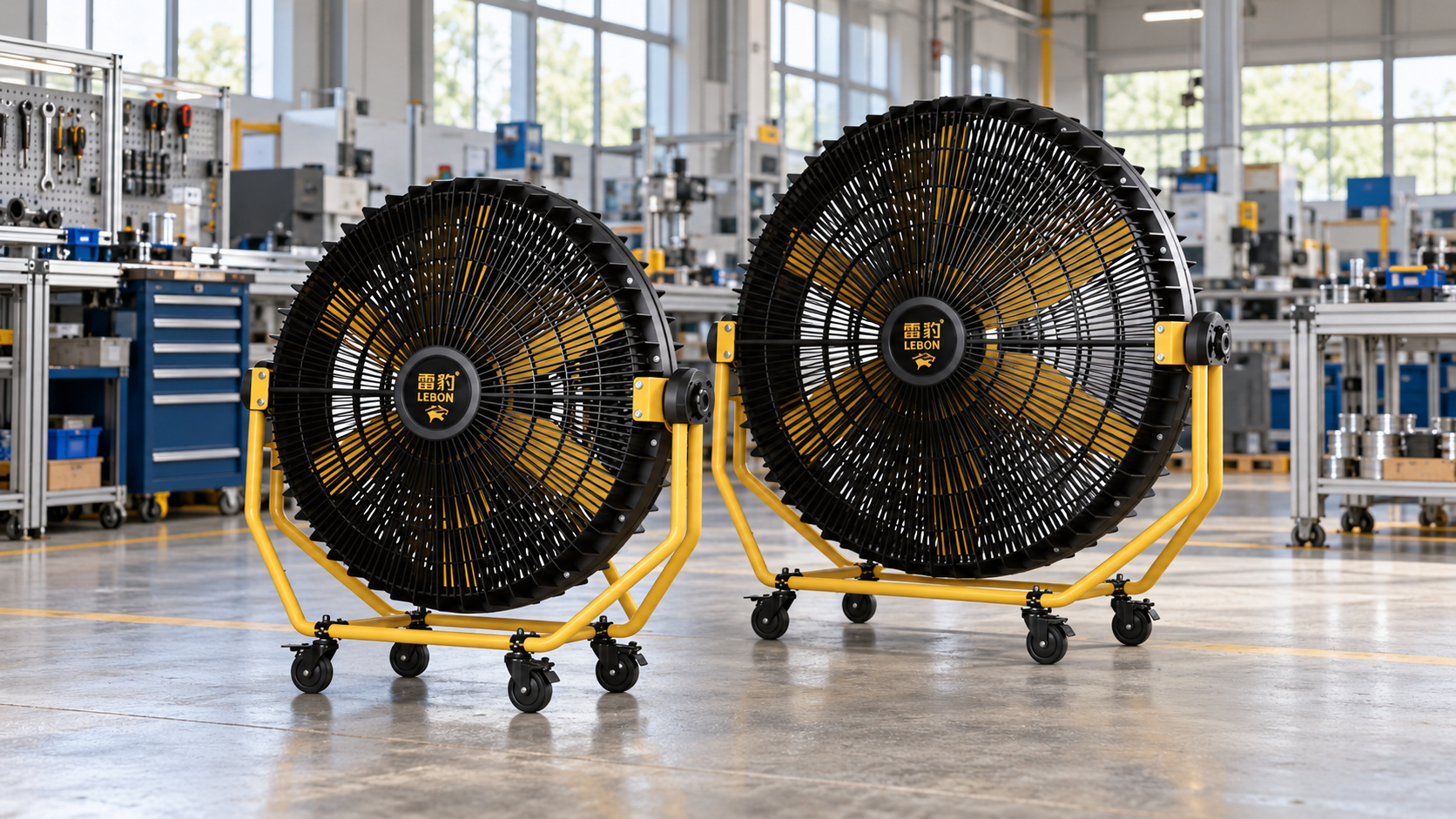
The purchase price of an industrial fan is only one part of its cost. In warehouses, workshops and production areas, fans may run for long shifts. Therefore, power use, speed settings and daily operating hours all affect the final bill.
A BLDC industrial fan uses a brushless direct current motor. However, the motor type alone does not tell you how much electricity the complete fan will use—or whether it delivers the airflow your site needs.
To make a useful comparison, start with the same task. Then, compare measured power, working hours and the number of units required.
What Determines Industrial Fan Running Cost?
For a basic electricity estimate, you need four figures:
- Average electrical input power in watts.
- Operating hours per day.
- Operating days during the period.
- Electricity price per kilowatt-hour.
Use this formula:
Electricity use (kWh) = power (W) ÷ 1,000 × operating hours
Then calculate:
Electricity cost = electricity use (kWh) × electricity price per kWh
For several identical fans running the same schedule, multiply the result by the number of units.
These formulas estimate energy charges. If your business tariff includes demand charges or different prices at different times, include those separately.
Separate Rated Power from Actual BLDC Fan Energy Use
Rated power is a useful starting point, but it is not a measurement of energy use across every shift.
A variable speed industrial fan may draw different amounts of power at different settings. As a result, using one rated figure for all operating hours may give a different result from actual use.
For example, LEBON lists rated power of 520 W for its 30-inch mobile barrel fan and 530 W for the 36-inch version. These figures support an initial estimate, but buyers should request input-power data for their intended operating settings.
When reviewing BLDC fan energy use, ask for:
- Complete-fan electrical input power, including the controller.
- Measurements at the speed settings you expect to use.
- Supply voltage and frequency during testing.
- Airflow and noise data measured under stated conditions.
For a site trial, measured kWh over a normal shift provides a stronger basis than a single momentary reading.
Calculate Industrial Fan Running Cost: A Simple Example
Assume one fan draws an average of 520 W throughout an eight-hour working day. It runs for 26 days per month, and electricity costs US$0.15 per kWh.
| Calculation | Result |
|---|---|
| Power in kilowatts: 520 ÷ 1,000 | 0.52 kW |
| Monthly hours: 8 × 26 | 208 hours |
| Monthly electricity use: 0.52 × 208 | 108.16 kWh |
| Monthly energy cost: 108.16 × US$0.15 | US$16.22 |
| Monthly energy cost for 10 identical fans | US$162.24 |
This is an illustrative calculation, not a measured LEBON operating result. It assumes constant average input power and a flat electricity rate. Replace these inputs with your own readings and tariff.
Also, compare the full installation. A lower-power fan may not reduce total costs if more units are needed to serve the same workstations.
Compare a Variable Speed Industrial Fan Across a Full Shift
Many sites do not need the same airflow all day. A packing area may need stronger airflow during busy afternoon hours and a lower setting earlier in the shift.
Therefore, calculate each operating period separately.
The following example uses hypothetical measured inputs, not published LEBON speed-setting data:
| Operating period | Average input power | Daily hours | Daily electricity use |
|---|---|---|---|
| Lower-speed operation | 200 W | 4 | 0.80 kWh |
| Higher-speed operation | 500 W | 4 | 2.00 kWh |
| Total | — | 8 | 2.80 kWh |
At US$0.15 per kWh, the daily energy cost would be US$0.42.
By comparison, operating continuously at 500 W for eight hours would use 4.00 kWh and cost US$0.60. The difference is US$0.18 per day under these assumptions.
However, the lower setting must still provide suitable airflow. Do not assume that half the speed means half the power, or that numbered speed settings represent equal steps in energy use.
Compare Industrial Air Circulators at the Same Useful Output
A fair comparison asks how much electricity each fan needs to perform the same job.
First, define the target working area. Then, compare the airflow reaching that area at an acceptable noise level.
| Comparison point | What to check |
|---|---|
| Airflow volume | Use the same units and comparable test methods |
| Air speed at workstations | Measure at the same distance and height |
| Coverage | Check whether all intended workstations receive airflow |
| Noise | Compare at the settings needed for the task |
| Electrical input | Measure complete-fan power under those conditions |
| Number of units | Compare total installation power |
Fan diameter alone does not establish efficiency. Likewise, air throw is not the same as airflow volume or effective coverage.
An industrial air circulator moves air within a space. Its role should also be distinguished from equipment designed to extract air from the building.
Match LEBON BLDC Industrial Fans to Your Layout
LEBON offers several fan formats, allowing buyers to consider placement alongside power use.
30/36-inch Mobile Industrial Barrel Fan
This range combines a BLDC motor, seven manual speed settings, adjustable tilt and casters. It provides an option for directing airflow towards work areas that may change position.
30/36-inch Mobile Oscillating Industrial Pedestal Fan
The pedestal range uses a raised stand, automatic oscillation, adjustable tilt and seven-speed control. Buyers can assess whether this arrangement suits their workstation layout.
30/36-inch Wall-Mounted Industrial Fan
The wall-mounted range keeps floor space available and offers remote selection of seven speed settings. This can make adjustment more convenient after installation.
Choose the format that delivers useful airflow to the intended area. Then, compare energy use at the required settings.
Include Maintenance in Your Running Cost Comparison
Electricity is only part of ongoing operating cost. Cleaning, inspection, replacement parts and downtime also affect the budget.
Before ordering, ask about:
- Access for cleaning the blades and grille.
- Inspection requirements for mounts, casters and fasteners.
- Availability of motors, controllers and other spare parts.
- Warranty terms and service support.
- Maintenance instructions for the exact model.
A brushless motor does not make the whole fan maintenance-free. Follow the product manual and include routine care in the purchasing decision.
Request the Right Data Before Buying a BLDC Industrial Fan
For a useful quotation, send LEBON your floor plan, working hours, supply voltage, required quantity and preferred installation type.
Then, request model-specific information on input power, speed settings, airflow, noise and spare parts. Where possible, trial a sample during a normal shift and record both electricity use and airflow at the workstations.
The best comparison combines industrial fan running cost with the airflow your team actually needs. Contact LEBON to discuss suitable BLDC industrial fan options for your warehouse, workshop or production area.


