Industrial Fan Types: Features, Applications and How to Choose One
News Details
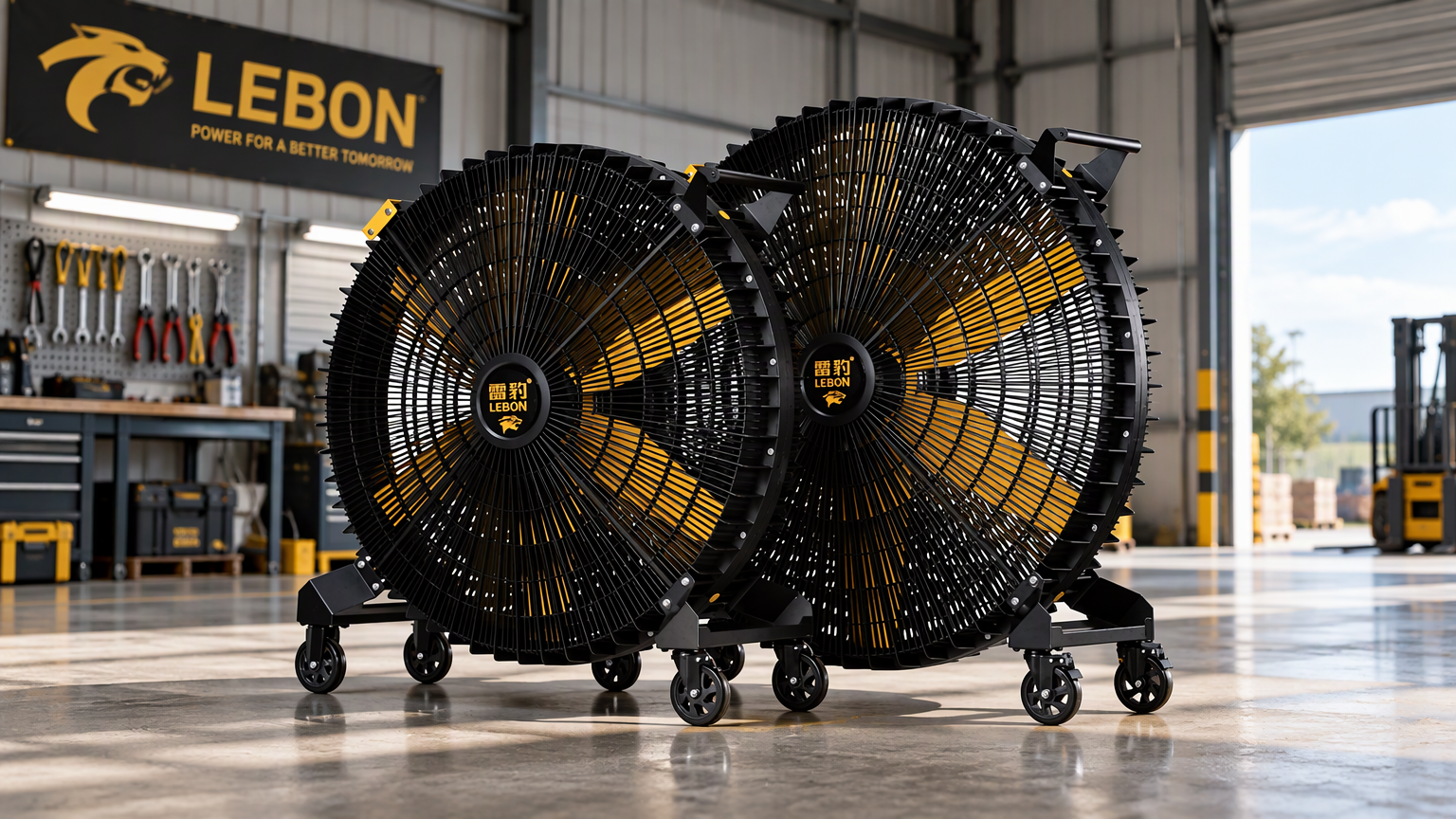
What Is anIndustrial Fan?
An industrial fan is a heavy-duty air circulation unit built to move large volumes of air in demanding spaces: factories, warehouses, workshops, gyms, and commercial premises. Unlike a small domestic fan, an industrial fan is designed for continuous operation, long air-throw distances, and the dust, heat, and daily handling of working environments.
Choosing the right type starts with the job the fan must do: general air circulation, spot cooling at a fixed workstation, or directed airflow across a wide working area. Ningbo Lebon Mechanical & Electric Technology Co., Ltd. (LEBON) has manufactured evaporative cooling and air circulation products since 2015, and its industrial fan range covers the three mobile formats most buyers need: barrel fans, oscillating pedestal fans, and wall-mounted fans.
Industrial Barrel Fans: High-Volume Airflow for Large Spaces
A barrel fan (sometimes called a drum fan) uses a cylindrical housing to project a strong, concentrated stream of air across long distances. This makes it the go-to choice for large open floors, loading areas, and spot cooling at a distance.
The LEBON range includes the 30-inch and 36-inch EF3025D and EF3625D barrel fans for flexible positioning in workshops and automotive bays, and the larger EF4225S and EF4825S models for wide warehouse floors. Both of the larger models are rated at 600W and driven by a high-efficiency brushless DC motor, with seven-speed control to match airflow to the task. A six-blade design moves air across large working areas, a radial airflow guide helps direct air farther, and the listed air delivery distances are 30 metres for the 42-inch model and 35 metres for the 48-inch model. Four heavy-duty 5-inch casters, a metal support frame, and handles make repositioning convenient, and a patented all-plastic grille structure surrounds the blades.
Oscillating Pedestal Fans: Airflow That Sweeps the Work Area
Where a barrel fan projects a fixed-direction stream, a pedestal fan raises the fan on a stand and adds automatic oscillation. The LEBON EF3025BK and EF3625BK oscillating pedestal fans sweep across a wide angle, spreading moving air across several workstations or bays instead of one spot.
This format suits open production areas where people and machines are spread across the floor and no single fixed direction would cover them all. Depending on the model, features include multiple speed settings, adjustable tilt, and automatic oscillation, so operators can tune both the height and the sweep of the airflow.
Wall-Mounted Industrial Fans: Circulation Without Losing Floor Space
In workshops, gyms, and commercial areas where floor space is at a premium, a wall-mounted fan keeps the air moving without occupying any floor area. The LEBON EF3025HK and EF3625HK wall-mounted fans mount at height, offer remote control with seven speeds, and provide 90-degree automatic oscillation, so airflow can be adjusted from floor level.
Mounting at height also keeps the fan safely out of the way of trolleys, forklifts, and daily traffic. Installation requires solid mounting points and fasteners, and the trade-off versus a mobile fan is that the unit stays where it is installed.
Brushless DC Motor Fans: Efficient Power for Long Shifts
The motor is the heart of any industrial fan, and the choice between traditional AC motors and brushless DC (BLDC) motors has a direct effect on running cost and service life. A BLDC motor drives the fan through electronic commutation rather than carbon brushes, which reduces friction-related wear and supports precise multi-speed control.
Selected LEBON fans and coolers use high-efficiency BLDC motors, including the EF4225S and EF4825S barrel fans rated at 600W with seven-speed control. For buyers specifying equipment for continuous daily operation, the brushless platform is aimed at longer service life and less maintenance than brushed designs, while multi-speed control keeps power draw matched to actual conditions instead of running flat out all day.
Air Throw Distance: A Key Selection Figure
Air throw distance is how far a fan still delivers useful air speed into the space. It is one of the most practical selection figures for large rooms, because it tells you how many units you need and where to place them.
Throw distance depends on blade diameter, housing shape, and outlet velocity, and it is not the same as airflow volume: two fans moving similar air volumes can project that air very different distances. Within the LEBON range, listed air delivery distances reach 30 metres on the 42-inch EF4225S and 35 metres on the 48-inch EF4825S, which is why these models are specified for wide warehouse floors and logistics buildings. Smaller barrel and pedestal formats serve shorter distances where repositioning is frequent.
Industrial Fans for Warehouses and Logistics Buildings
Warehouses concentrate the problems industrial fans are built to solve: high ceilings where hot air collects, racking that blocks natural airflow, and loading doors that open continuously through the shift. Fans help break up heat pockets and keep air moving at ground level, which improves comfort without trying to refrigerate the whole building volume.
In practice, warehouse air circulation usually combines formats: a 48-inch barrel fan such as the EF4825S for long-distance air movement along open aisles, wall-mounted fans above packing stations where floor space is occupied, and pedestal fans where the layout changes with the season. Because LEBON fans run on casters, they can be redeployed as the racking layout changes, and casters with brakes keep the fan stable once positioned.
Heat behaviour explains why circulation matters as much as cooling. In a tall building, warm air rises and gathers near the roof while staff work in a cooler but often stagnant layer at ground level. Moving air across the floor breaks up these pockets, helps moisture evaporate from surfaces, and makes any existing cooling equipment work more evenly across the building rather than only near its outlets.
How to Choose an Industrial Fan: A Buyer's Checklist
A short checklist keeps the selection grounded in the actual site:
- Define the job. Circulation across a wide area favours oscillating formats; a concentrated stream over distance favours a barrel fan; fixed stations with no floor space favour wall mounting.
- Match size and throw. Blade diameter drives both air volume and throw distance, so measure the distance the air actually needs to travel.
- Check speed control. Multi-speed or seven-speed control lets one unit serve different conditions across the day.
- Consider the motor platform. BLDC models suit long daily shifts and lower running costs.
- Plan mobility and safety. Casters, handles, brakes, and protective grilles determine how the fan behaves in busy traffic areas.
- Confirm market compliance. Relevant LEBON products carry CCC, CE, CB, and ETL certification and comply with RoHS requirements, and voltage and plug types can be confirmed for the destination market.
LEBON manufactures at its own factory in Ningbo, China, and supplies buyers across Southeast Asia, the Middle East, South America, Europe, and Africa. For the full fan range, specifications, and OEM options, visit the LEBON website.


