Evaporative Air Coolers: Functioning Mechanism and Model Selection Guide
News Details
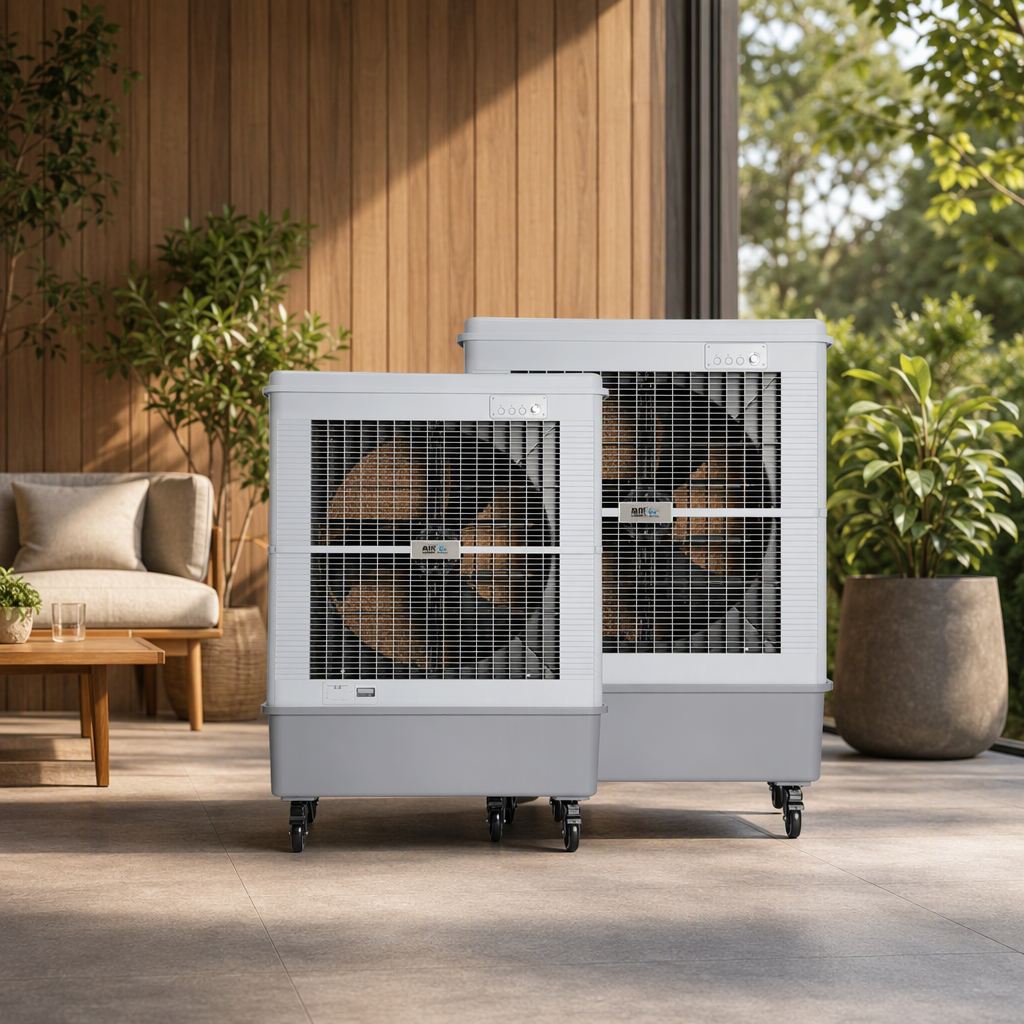
What Is an Evaporative Air Cooler?
An evaporative air cooler is a mobile cooling unit that lowers room temperature using the natural principle of water evaporation. A fan draws in hot external air and forces it through a wet cooling pad. As the water evaporates, it absorbs heat from the air, producing cooled, humidified fresh air that is then blown into the room. Unlike traditional compressors, this system requires no refrigerant or compressor, so it can be plugged into any standard outlet and placed anywhere.
This technology is especially suitable for international purchasers who need cooling equipment for hot, dry environments such as manufacturing workshops, warehouses, retail stores, or open production areas. Ningbo Lebon Mechanical & Electric Technology Co., Ltd. (LEBON) has specialized in evaporative cooling and air circulation products since 2015, manufacturing portable evaporative air coolers for residential, commercial, and industrial applications at its own factory in Ningbo, China.
How Does an Evaporative Air Cooler Work?
The principle is straightforward: a small water pump draws water from the built-in water tank and distributes it evenly across the cooling pad. The fan pulls hot external air through the wet pad. When the hot air comes into contact with the water, the water evaporates and absorbs heat energy, lowering the air temperature. The resulting cool, fresh air is then supplied to the room.
Three key factors influence performance:
- Ambient humidity. Evaporative cooling works most effectively in dry air. The lower the humidity, the greater the cooling effect. In humid environments, evaporation slows down, resulting in lower cooling performance.
- Ventilation. Because the system introduces fresh air, it also adds moisture to the room. Therefore, the space must have sufficient ventilation. Keeping doors, windows, or vents open allows humid air to escape and maintains continuous and effective cooling throughout the day.
- Water consumption. The unit must be connected to a water supply or the built-in water tank must be refilled periodically. How often water needs to be added depends on the model, ambient temperature, humidity, and daily operating hours.
An evaporative cooler does not cool like a refrigerator—it cannot maintain a constant set temperature. Instead, it continuously supplies cool fresh air, which is exactly what most open industrial and commercial spaces require.
Evaporative Air Cooler vs. Air Conditioner
Many buyers wonder how these two cooling technologies compare. They use completely different cooling principles and are suitable for different building types.
| Criterion | Evaporative Air Cooler | Air Conditioner |
| Cooling principle | Water evaporation through wet cooling pad | Refrigerant compression cycle |
| Installation | Simply plug it in and fill the water tank; mobile units can be moved freely | Requires fixed installation and professional setup |
| Air supply | 100% fresh outdoor air | Recirculated indoor air |
| Suitable for | Open and ventilated areas such as workshops, warehouses, shops | Sealed and insulated rooms with a constant set temperature |
| Maintenance | Cleaning the water tank, cooling pad, and pump | Regular filter, coil, and refrigerant service |
A practical rule of thumb: In large, open, or semi-open spaces where doors are open throughout the day, air conditioning systems are expensive to run and quickly lose cooling efficiency to the outside air. Evaporative coolers operate reliably under these conditions while consuming significantly less energy.
Choosing an Evaporative Cooler for a Workshop
Workshops often combine heat from machinery or production processes with wide-open doors. Therefore, matching the cooler to the workspace is more important than simply choosing the largest unit. Consider four main factors: the size of the area to be cooled, the air delivery distance, operating hours per shift, and where the unit can be placed or moved.
The LEBON EC5324D is a good example of a mobile unit designed for commercial and industrial use. It features a 400W brushless DC motor, offers 7 fan speed levels to adapt airflow to conditions, and uses three-sided air intake combined with an integrated water distribution system to ensure consistent airflow through the cooling media. Four 4-inch metal wheels make it easy to reposition the unit along the production line as workstations change, while the low-noise fan blade design balances cooling performance with operating noise levels.
The Best Air Cooler for Warehouse Spaces
Warehouses and logistics buildings have specific characteristics: large open floor areas, high ceilings, heat accumulation near the roof, and loading doors that are continuously opened and closed. Cooling the entire air volume of such a building is often uneconomical. A more practical approach is to cool the work zones and maintain consistent airflow at working height.
For these larger applications, LEBON offers the MFC12000D and MFC18000D industrial mobile coolers, equipped with 24-inch and 30-inch fans respectively. The larger fan diameter combined with evaporative cooling provides sufficient air delivery to cover wide work areas, while the ABS housing with a metal frame is designed to meet the demands of industrial and logistics environments. In dry climate regions such as the Middle East, this class of unit is commonly used for spot cooling in densely packed work areas with open door ventilation.
Placement is also part of correct sizing. Because these units are mounted on heavy-duty wheels and allow adjustable airflow direction, they can follow seasonal layout changes and concentrate cooling where employees actually work. Positioning the unit so that fresh outdoor air can enter and humid air can escape is key to maintaining stable cooling performance throughout a full shift.
Portable Evaporative Air Coolers for Homes, Shops, and Wet Areas
The same technology can be scaled down or up to meet different requirements. LEBON's product range includes compact household models such as the MBC1800 and MBC2800 with dual centrifugal blowers, commercial and residential units such as the EC3820/EC4520 and MFC3600/MFC6000 series for retail stores, restaurants, and showrooms, as well as larger industrial units. All are mobile wheeled units, meaning cooling can be adjusted to suit the room layout rather than being fixed to one location.
For wet or washdown environments such as food processing areas, the ES0535T and ES1055S stainless steel models combine evaporative cooling with a corrosion-resistant housing—a common requirement in humid production zones.
Evaporative Cooler Maintenance Basics
Maintenance requirements are low, but seasonal planning helps ensure performance. The essential routine tasks are simple: clean the water tank, keep the cooling pad free of limescale and dust, check the pump and water distribution system, and drain the unit before extended storage. Hard water accelerates limescale buildup on the pad, so cleaning intervals should be adjusted to local water quality and usage hours. Dusty environments such as woodworking or textile workshops require more frequent cleaning of the air intake grille. Since the cooling pad, water tank, and pump are the main wear parts, most maintenance can be handled by on-site staff, and spare parts can be ordered with the shipment.
Energy-Efficient Industrial Cooling
Energy consumption is where evaporative cooling stands out. With no compressor, the main power consumers are the fan and a small water pump, and selected LEBON models use high-efficiency brushless DC (BLDC) motors for lower operating costs over long shifts. These units do not use refrigerants, making environmental compliance simple for export markets.
LEBON manufactures in-house in Ningbo, and relevant products carry CCC, CE, CB, and ETL certifications and comply with RoHS requirements. Products are supplied to buyers across Southeast Asia, the Middle East, South America, Europe, and Africa. To discuss models, voltage and plug options for your market, or OEM requirements, visit the LEBON website.


